“Take Off Your Bracelets”

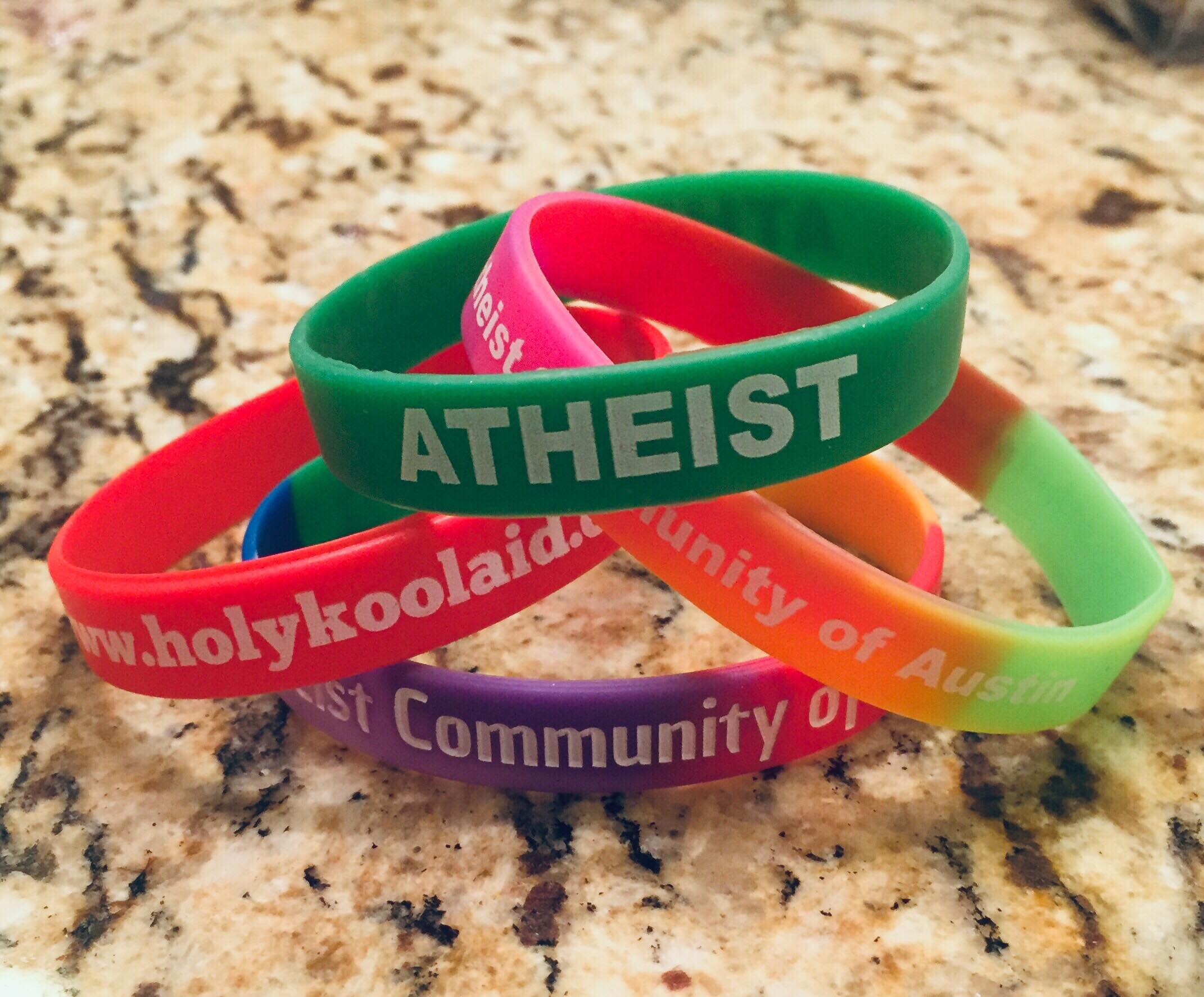
Thanks to ObjectivelyDan, the ACA, and Holy Koolaid for the awesome bracelets 🙂

Let’s talk about double standards.

You’ve seen them. Bible verses on home decor. Cross necklaces. T-shirts with words like “faith” on them. WWJD bracelets. Guest room bibles. Nativity sets. Or maybe you’ve heard it. “Let’s bow our heads and thank the Lord for our dinner.”

All of these things are expressions of faith, and among Christians, are normal.

But when I simply wear a bracelet with the word “atheist” on it, suddenly I’m being offensive or disrespectful.

How is that fair?

Here’s a hint: it isn’t.

I have four bracelets with the word “atheist” on them, and one that simply alludes to atheism. To me, wearing these are the same as a Christian wearing a cross necklace or a WWJD t-shirt. But to others, it is me pushing my beliefs on them.

I’m home from college for Memorial Day right now, and my aunt, uncle, and teenage cousins are spending the weekend at my parents’ house.

Before they arrived, my dad (a former Catholic who I would call an agnostic, cultural Christian) took me off to the side and said, “Take your bracelets off before your cousins get here.”

Now, I love my parents, and for the most part, I can talk about being an atheist around them. We disagree on fundamental religious beliefs, but I can generally be open around them. I’ve had similar conversations to the one above that didn’t end too well.

My cousins, on the other hand, don’t know about my lack of belief (as far as I’m aware). Their family is religious, but our families as a whole tend to avoid the topic around each other.

But I refuse to pretend I don’t exist.

If my family members can wear cross necklaces, I can wear atheism bracelets.

I’m not standing around actively watching atheist videos around them. I’m not handing them copies of “The God Delusion.” I’m simply existing.

My cousins are old enough to understand that people like me exist.

If they ask me questions, I’d be happy to openly discuss things with them. But as of right now, I’m doing the same thing they are. Existing.

And I’m not going to hide, simply because my religious family wants me to. I’m openly, vocally atheist, because the general public has a bad view of people like me.

If more people know I’m an atheist, maybe they’ll change their minds.

Maybe they’ll understand that atheists can be friendly, kind, caring, open-minded, respectful people who just want to make the world a better place.

I refuse to let people keep believing that atheists are evil, immoral, mean, people.

I refuse to hide.

Thoughts on Alabama’s New Abortion Law

For those of you who don’t know, I have lived in Alabama for most of my life. I grew up in a great city with lots of educational opportunities, and for the most part felt okay about speaking my mind.

Now, I attend a small college in the middle of nowhere, and while I love the environment, my education, and all of the wonderful friends I have made over the past four years, I’m not able to speak my mind without getting a lot of backlash.

Yesterday (May 15th, 2019), Alabama Governor Kay Ivey signed the United States’ most severe abortion ban. The ban does not include exceptions in cases of rape or incest. This is horrifying to me, because even though rape and incest make up a small percentage of abortions, they still happen, and it is absolutely sickening that this state will now force these girls (yes, GIRLS) and women to carry their rapist’s children, even if they don’t want to.

I could go on and on about this, but my friend Katie put it best. Katie is religious, and while she and I view the world differently, we see eye-to-eye on this issue. I’ll let her take it from here.

Today’s Tea by Katie Cline

The State of Alabama wasn’t there for me in 7th grade when I got my first period and didn’t know what to do. But my mom was. The State of Alabama didn’t help me wash the blood out of my pants. But my mom did. All the State of Alabama did was say, “Remember to bring pads and tampons to school because they won’t be provided for you.”

The State of Alabama wasn’t there for me every month since then that I’ve gone to school and/or work one or more days feeling exhausted and in pain. But my girlfriends were, armed with Tylenol, a salty snack, and empathy. All the State of Alabama gave me was the expectation to do well on that week’s standardized test.

The State of Alabama sure wasn’t there for me in 10th grade when I was supposed to be learning about safe sex, condoms, and birth control. But the Internet was. Cosmo magazine was. My older friends were. All the State of Alabama gave me was 50 free minutes to talk to my friends and a worksheet I don’t remember. (Health class what?)

So after 23 years of negligence, the State of Alabama has decided that it gets to tell me what to do with my body, this beautiful thing that I have raised and nurtured and tried my best with. Suddenly, the State of Alabama knows what’s best for me, after a lifetime of telling me that I’m not a priority. The State of Alabama wants me to hypothetically suffer the horrors of rape and a potential pregnancy that I may not be physically, mentally, emotionally, or financially capable of sustaining and punish me as a murderer if can’t do that.

I should be surprised. But after 23 years of being told through words and actions that my female body does disgusting things that I should be ashamed of, things I should hide and not talk about, things that the men in my life “don’t want to/need to hear about,” I’m not surprised that the State of Alabama would do this.

States that pass these laws are afraid. Afraid of female autonomy, because they know they have never provided women any support in navigating womanhood, and, yet, we’re navigating it. We were never taught about our bodies in school, so we went out and taught ourselves through word of mouth and blogs and support systems. They did not give us a voice, so we came forward. They did not listen, so we marched. They did not relent, and we did not give up, and now we are a force.

I am so angry at how I’m being treated by the place I consider my home.
At how my mother was treated before me and how my children could be treated after me. This is not right. This is not fair. This will not end well. (Trust me. I’ve read the book.)

Why I’m an Activist

Guest post by Inquisitive Quandary

I recently met and started talking with Inquisitive Quandary on Twitter. I really like what they have to say about secularism, and I invited them to share some thoughts on my blog. Here’s what IQ has to say:

Hello Christy, thanks for the opportunity to share my story.   First off, the initials for my username, “IQ,” were unintentional. The name Inquisitive Quandary was intended to reflect the importance of not just questioning the things that perplex us the most, but questioning the very questions we ask ourselves.   

I’m no genius, nor do I dare assume intellectual superiority to anyone I come across. We all decide our own level of ignorance. Don’t be afraid to be wrong.  

I agree it seems mundane to question ourselves on the fundamentals we all take for granted – even the most basic concepts such as what you believe makes you, you. What do I like? Why? At a glance it sounds trivial, but how do you plan to really respect others’ desires if you don’t fully understand your own?   

I’ve spent the better part of my adult life trying to separate myself from the atrocious mind traps of vanity, fashion, masculinity, racism and even “common sense ”       

So while I don’t necessarily have a spectacular deconversion story, it is my decision to stand up and speak out against absurdity that best defines me. I’ve been openly atheist for most of my life, but it is the activist in me that has been recently awoken. My family is falling further and further into the grips of religion and I can no longer hold my tongue. Please don’t confuse my being incognito for cowardice.    

I couldn’t imagine leaving my family over something like a conflict of ideas. Never give up on the ones you love, no matter the cost. It is the adoption of secular humanism that has allowed me to see past the labels we all wear on our sleeve and see the world and the people in it in a much better way.    

Through the trolling, ignorance, and hatred lies a real person who’s just been misled. It’s reasonable to admit there are many that are unaware or unwilling to change. All we can do is try. Indifference has only ever had one outcome. So if I have to change the world to save my family or at least one person from bad ideas, I’ve got better odds than doing nothing.    

So if you value freedom of the mind,    

If you value compassion,    

If you value unity and community,   

Stand up and speak out! Let’s go change the world one good idea, one good person at a time. Consider, that’s the only way it’s ever happened.            

Thank you for your time – IQ

Let’s Talk About Mental Health

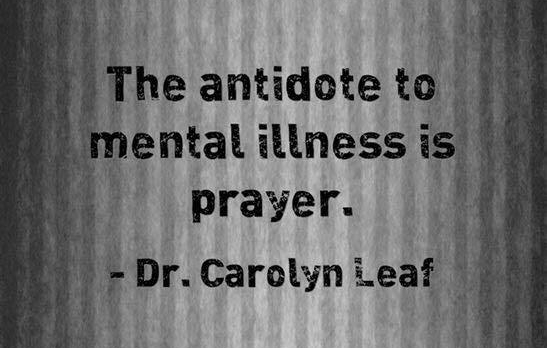
The antidote to mental illness is NOT prayer. Religion is NOT a substitute for treatment.

For seven years, I struggled with anxiety, depression, suicidal thoughts and tendencies, and panic attacks. I’m better now, but sometimes I still struggle.

In honor of May being Mental Health Awareness Month, I thought I’d share my story.

In 2012, I was diagnosed with moderate to severe depression and anxiety. I had struggled for months beforehand, not knowing what caused me to feel so awful all the time.

I had depressive episodes, anxiety, non-existent self-esteem, and a constant cloud of numbness hanging over my head. My grades slipped. I lost friends. I started hanging out in my room with the door closed, getting sucked in to Facebook. And while this wasn’t as bad as it could get, people noticed.

I’m normally an extremely outgoing, bubbly person, but at the time, I was the total opposite.

I visited a psychiatrist and a therapist. I was prescribed medication and weekly therapy sessions that I attended for nearly two years.

Things got worse before they got better.

I struggled with self harm. I had suicidal thoughts. I even planned how I would end my own life, twice.

When I started therapy, I was religious, but obviously I’m not anymore.

Reading bible verses helped me sometimes.

Sometimes they didn’t.

What helped me the most over the past seven years was taking medication, going to therapy, practicing what I learned, and learning various coping techniques.

I’ve noticed some Christians talk about mental illness like it isn’t real, saying “Jesus is the only thing that can cure your depression.” And while it’s fine to use religion as a coping technique, it’s important to remember that mental illness is a complicated thing. What works for one person may not work for another.

It has been proven that therapy and medication WORK. That’s why it is so highly recommended.

Don’t get me wrong. While I think religion made things worse for me (“you’ll go to hell if you kill yourself,” “just pray and things will get better”), it can definitely act as a positive coping technique for others.

I see no issue in using religion to help you cope if it makes you feel better.

But Jesus is not a replacement for treatment. If you are struggling, GO GET HELP.

If you or someone you know is struggling with mental illness or suicidal thoughts, here are some resources:

You are loved. You are needed. You are not alone.

Reach out. Ask for help. You’ll be glad you did.

Give Yourself Some Credit

As finals week and graduations approach, I’ve been preparing myself for the onslaught of Facebook, Instagram, and Twitter posts thanking God for every achievement.

“I made an A! God is so good.” “I wouldn’t have made these grades without God.” “I’m graduating, have a job offer, and made the best grades, all thanks to God.”

While these kinds of posts seem harmless at first glance, they can also be an unhealthy way of thinking.

Gratitude is important. Humility is fantastic.

But God didn’t take your finals. God didn’t stay up all hours of the night, studying for your tests. God didn’t turn in your homework. God didn’t apply to those jobs, build up your portfolio, or kill that interview.

YOU DID.

Give yourself some credit!

You may not want to seem like you’re bragging, and I get that.

But if you’ve accomplished something big, you deserve to feel proud of yourself. You deserve to feel good about all the hard work you put in. You deserve the credit.

You’re allowed to be religious. You are allowed to be thankful that you had religion as a stress relief (or however you use it). You are allowed to post things that credit your god for anything you do.

But remember…

You still did those things, and you should be proud of everything you accomplished.

Being an Atheist on Easter

I live in the south. I am constantly reminded that Christianity is the majority religion around here. But on days like today – Easter – I am bombarded with Jesus posts.

This is my second Easter as an atheist. Last year, I had to work on Easter, so while the day was a little odd, I was busy, so it didn’t bother me too much.

This year is different, though. Today I stayed home to study for finals, while my parents went to the church where my younger sister directs the choir. I know my parents knew I was busy, but it was strange being excluded from the normal festivities.

In the south, today is a day where people like us are reminded – constantly – that we are different. Our social media pages are flooded with virtue-signaling posts, with people proclaiming their religion without any fear. And that’s fine.

But what sucks the most is that I can’t do the same thing with my own beliefs.

Here in the south, it is taboo to be openly atheist. It is taboo to talk openly about what you believe…unless you’re Christian.

On days like today, I am reminded that if I were to post something about how freeing atheism is, about how I don’t believe in God, or even just mentioning that I am an atheist, I would be hounded and shunned from certain people simply for expressing my beliefs in the same way Christians express theirs.

Today, I am met with Bible verses. I’m met with Facebook statuses like this one:

Today, I want to make it clear that I am a Christian, and I Love Jesus Christ! I believe that Jesus Is the Son of God, that He was crucified on a cross, died for my sins and rose again on the 3rd day to offer me salvation. He loves me dearly and forgives my sins. The Bible says if I deny him, he will deny me before his Father In Heaven. This Is The best challenge I’ve​ ever seen on Facebook. and quite frankly for those that know me…. this is a no-brainer. No matter your faith you have nothing to lose. So If you love Jesus and you’re not ashamed, just replace my name with yours and make this your update. I stand for Jesus every day…And I love Him in every way! ✝️

If I were to make my own status as an atheist that said:

Today, I want to make it clear that I am an atheist, and I don’t believe in God! I believe the stories in the Bible, the Quran, and every other holy book are fiction. I love myself as I am and I am responsible for my own actions. I believe that evolution is a true fact, and that separation of church and state should be followed. If we deny science, we will go nowhere in life. This is the best challenge I’ve ever seen on Facebook, and quite frankly, for those that know me… this is a no-brainer. No matter your faith, you have nothing to lose. So if you don’t believe in God and you’re not ashamed, just make this your status. I stand for freedom from religion every day, and I love myself just the way I am!

I would be CRUCIFIED (pun intended).

Can you imagine posting something so controversial? Christian posts like these make anyone who doesn’t believe exactly like the person posting, whether intentional or not, seem wrong and bad. That isn’t okay.

Believing whatever you want shouldn’t be controversial.

Speaking up for what you believe should not be met with shame and hate.

If Christians can speak freely about their own religion and specific beliefs on Facebook, we should be able to do the same thing.

Even though I am bombarded with religious posts today, I still have people who I CAN express my beliefs with. I have a family who (somewhat) accepts me. I live in a place where I most likely won’t be killed for speaking out.

But days like today remind me of those who can’t speak out. There are people out there who can’t speak up for what they believe for fear of being killed.

It’s unfair that any of us have to censor ourselves. We should be able to express our beliefs in the same way Christians do.

So let’s change that.

“Dysfunctional” Families

While scrolling through Facebook today, I came across an ad for a church called “Refuge Church.” Living in the south, I tend to get a lot of these kinds of ads, and sometimes I end up visiting the church website to see if I find anything interesting.

This time, I did.

I came across a 5-part sermon series about dysfunctional families. (Click here to see the original video.) Naturally, as an unmarried, childless college student, I had to watch.

Here are my thoughts on some of the things the pastor said in Part 1.

Disclaimer: While I’m okay with people believing in God if they aren’t actively hurting other people, I’m not okay with people essentially telling others, “If you don’t believe in my version of God and do exactly what I do, you aren’t a real Christian.”

1. “The words in Deuteronomy still hold true to you and I today.”

This is a prime example of picking and choosing. While there are SOME things in Deuteronomy that could be attributed to today, there are plenty of commands that are not in effect today.

For example, in Deuteronomy 7.2, God instructs the Israelites to basically murder anyone they come into contact with that isn’t an Israelite.

2. “The primary dysfunction of families is that they do not put God first.”

This is honestly infuriating, because it is so obviously false. Of course there is going to be dysfunction in some families, but it is often due to a lot of complex factors, rather than “not putting God first.”

These factors include: alcohol and other drugs, behaviors associated with aggression and violence against members of a family, juvenile delinquency and adult self-destructive behavior, family breakdown, narrowed emotional relationship in the family, the pathological behavior of parents. (Anna Kieszkowska)
K

Notice that none of these are god-related.

The pastor also says that “the greatest dysfunction we have as families is not putting God in our life – he’s an afterthought.” However, research shows that the most common family dysfunction is addiction.

In fact, Brown University Psychologists describe a common dysfunction: “one or both parents exert a strong authoritarian control over the children. Often these families rigidly adhere to a particular belief (religious, political, financial, personal). Compliance with role expectations and with rules is expected without any flexibility.” Seems a bit ironic.

3. “How can we overcome this factor, making us functional?”

The pastor says that the first thing anyone has to do to become a functional family is to love God.

Being a family is complex; there’s no one right way to do it. Church was not really a super big deal in my family. We went most weeks, but my family was generally relaxed about religion. We weren’t dysfunctional, though.

There can be families out there that struggle with addiction, abuse, etc., that identify with and practice Christianity. There are families that don’t struggle with those issues and are Christian, Muslim, atheists, and any other religion or non-religion.

Religion has nothing to do with whether a family is functional or not.

4. “It was the expectation when I was younger to go to church, not an option.”

Here’s my issue with this. It SHOULD be an option. People should be able to make their own decisions regarding religions. The pastor at Refuge Church encourages parents to “expect” their children and teens to go to church. He doesn’t want them to decide for themselves.

This is not healthy.

No one should be forced to believe anything. You can raise a kid to be Christian, but you should NEVER force a kid to ascribe to your religion.

5. “Grab a Children’s Bible and read them the stories until they can tell you the stories back.”

Indoctrinating kids is NOT okay. Teaching kids about your religion is fine by me, as long as you aren’t hurting anyone. But drilling something that discourages critical thinking, such as fundamental religion, into their heads isn’t good.

The rest of the video had more content that I understood: giving explanations for things rather than saying “God said so,” and leading by example.

Overall though, I thought the pastor at Refuge Church had good intentions with this sermon; however, some of the messages were not great.

It is never okay to force your beliefs on someone, especially if they’re too young to know that there are other options and ways of thinking.

It’s also not okay to spread false information. Saying a family is dysfunctional because they don’t worship your specific god is not okay. It diminishes real families who are actually struggling and causes distress in families that aren’t.

You don’t need a god to live a fulfilling, happy, life.

You don’t need a god to have a functional relationship or family.

God is not a requirement.

You are still good.

Sources:
https://www.findrefugehere.com/?wix-vod-video-id=863c7b9aa9b44440b295da7d89685441&wix-vod-comp-id=comp-jmjzso1x#

http://cejsh.icm.edu.pl/cejsh/element/bwmeta1.element.desklight-55a92456-b4a4-45f4-a4e5-f460f14a1f68

https://www.brown.edu/campus-life/support/counseling-and-psychological-services/index.php?q=dysfunctional-family-relationships

We Need to be Civil

Recently, I was watching a YouTube live stream where I heard someone say something along the lines of, “Don’t talk to me if you’re just going to present some idiotic bullshit.” While I understand what this person meant, it hurt the live stream’s viewership. This comment got me thinking…as atheists, we need to be more civil.

If we start out by shutting people down and excluding those we disagree with, we are cutting ourselves off from learning.

In psychology, there is a concept known as the “echochamber effect.” When we surround ourselves with only the things we agree with and refuse to listen to opposing viewpoints, we become close-minded, which is often the very opposite of what many atheists want to see from others.

There is a lot of hostility from both sides of the god debate. People telling other people they deserve eternal torture for not thinking exactly like they do. People calling other people names and refusing to listen to the other side because of how they were raised. And while the religious side has a lot of hostility to own up to (killing people who don’t believe, etc), many atheists are guilty of dividing us further.

There are always going to be extremists, and we should do our part in standing up for what is right.

But that does not mean that it is okay to treat moderately religious people the same way we would treat those extremists.

My family is religious. My best friend plays in a worship band on campus. My sister works as a worship leader at her church. I’m lucky that my family and friends (mostly) accept me for who I am, but there are times when we don’t agree on things.

When I talk to theists, I imagine how I would go about the conversation if I were talking to someone in my family or my best friend, and that usually helps me to say things in a kind way.

Religion has hurt a lot of people in a variety of different ways; however, if we are going to get anywhere with theists, we need to stop shutting them down too quickly.

Meaningful, civil conversation is something I really enjoy when conversing with anyone.

If theists are going to be rude to us in everyday conversations, so be it, but as people who already have a bad rap, it makes us look worse when we are rude in return.

Too many people see atheists as close-minded, rude, or argumentative, but I know that perception is off. We should be doing all we can to change the public perception of us.

Let’s be known for the open-mindedness, civilized, rational people that we are.

Let’s change the world.

I’m an Atheist, and That’s Okay.

I grew up in a progressive Christian household. We believed in evolution. We accepted and supported the LGBT+ community. We had women pastors. To us, Christianity was all about loving and supporting everyone. My family mostly avoided the topic of religion altogether, except for praying at dinner time and going to church.

Growing up, how “Christian” I was wasn’t a topic of importance in our house; however, I went through many phases of being extremely religious and not-so-religious, honestly depending on who and what I surrounded myself with.

I was first turned off by religion when I was 12. I was attending a Baptist day camp during the summer before I entered middle school. The kids in my class were between the ages of 10 and 13. I liked all of the new friends I was making, but I didn’t like how harsh everyone’s views – especially those of the teacher – were. We were told practically every day that if we did not do certain things or think certain ways, we would go to Hell.

I remember talking to my parents about this and thinking, “How do they know that’s where we will end up? Isn’t that God’s job to decide?”

Whenever I questioned anything, such as the six-day creation story, I was usually met with answers like, “you can ask God when you get to Heaven.”

Ultimately, I am glad that my parents didn’t use apologetics on me, but the answers they gave never really satisfied my thirst for answers.

In high school, I found a Christian blog that I began following religiously (pun intended). The blog was run by a former model-turned Christian, whose mission was to inspire girls to live in God’s image. I liked the body positivity and sense of community the website offered, so I ignored the posts about the things I disagreed with.

Reading that blog so often ended up with me indoctrinating myself further in to the religion. Dating or having atheist friends was wrong. Having friends of other religious faith was okay, but only if I’m sharing the gospel constantly. Sex was wrong. Dressing in certain clothes was wrong. So many things were just WRONG. Looking back, it was shaping me to be someone I wasn’t.

When I got to college, I went to church every once in a while, but I was so busy with extracurricular activities and schoolwork that I didn’t have the time or gas money to travel thirty minutes both ways for church every week.

I started dating an atheist. I had dated non-religious people before, and it was never a major problem, because I usually felt (and still feel) that religion was something private. This person, however, introduced me to Neil DeGrasse Tyson’s version of “Cosmos,” and I was immediately hooked.

I had always had a fascination for space and the stars, but “Cosmos” stirred up religious doubts. One episode in particular was about the possibility of life on other planets outside of our solar system. I realized that if there were so many planets out there that are similar to earth, there’s a possibility that some of that life is intelligent. It is not likely that the possible intelligent life knows about the Christian religion, namely Jesus. Therefore, with the possibility of life beyond our own planet, Christianity, to me, didn’t work.

From there, I started questioning things. Is there something out there? Is there a god? Is another religion correct?

If there is a god, I knew I would find it. Unfortunately, I found more sources refuting and debunking the evidence that theists gave than anything else. After months and months of questioning and researching, I realized that I had become an atheist.

And that’s okay.

Along the way, there were a lot of struggles and questions that I had. There were a lot of fears that I had to get over…but that’s a whole other post. I’ll get to that soon.

I’m glad I became an atheist, though.

If you’re questioning your faith, know this: it’s okay not to know all the answers.

It’s okay to have doubts.

It’s okay to question what you were taught.

Life is more interesting that way.